Sometimes the beauty of a bird lies not in its plumage or color but in its song.
Definitely the case for this Palawan endemic songster: the uncommon Melodious Babbler, Malacopteron palawanense. The field guide describes it as a very vocal, but shy and hard to see bird as it prefers the understory and canopy of low trees in second growth forest and forest edge, perching in dense tangles and vines. Though this beautiful bird maybe just plain brown and drab, the song is a harmonious melody described as a 5-note rhythmic whistle sounding much like “I can see you there.” The call’s description probably came from the birds habit of not showing itself completely, preferring to stay in the dense tangles and mocking all birders trying to locate it. 🙂
Melodious BabblerMalacopteron palawanense February 2011, Puerto Princesa, Palawan, Philippines Video by Nicky Icarangal, JR. Digiscoped with a Swarovski ATM 80 HD, Canon Powershot S95 with Swarovski UCA.
Here is another short video clip: an Elegant Tit singing its heart out in cool and breezy Mt. Polis, the Cordilleras, Luzon, Philippines.
The Elegant Tit is a widespread Philippine endemic that can be found in most islands of the Philippines except Palawan (where it is replaced by the equally-charming Palawan Tit). It is one of the core species of mixed flocks, and is usually seen feeding with Philippine Bulbul, Sulphur-billed Nuthatch, and Blue-headed Fantail (in Luzon) and Black and Cinnamon Fantail (in Mindanao).
Though common, it is a pretty bird to watch and hear with its distinctive yellow and black plumage and its nice, melodious, always cheerful song. Another thing nice about this bird is that once you hear it calling, chances are there are other small birds present as well. Happy birding week everyone!
The Celestial Monarch is one of the most-sought after birds after the Great Philippine Eagle in any birding trip to the Philippines. The excellent field guide “A Guide to the Birds of the Philippines” by Robert Kennedy, et al. describes it as “gorgeous” with itsbright cerulean blue head with long slender crest feathers swaying in the wind down its cobalt blue back. When excited, the crest feathers rise up.
This rare endemic can be found in the lowland forests of Luzon, Samar, Negros, Tawi-tawi and Mindanao where it forages singly or in mixed flocks in the middle and upper canopy of forests and forest edge. In Mindanao, where this video was taken, it is often mixed in feeding flocks together with Short-crested Monarchs, Blue Fantails, and Rufous Paradise Flycatchers.
Sadly, the number of these beautiful endemics have been declining rapidly as a consequence of widespread and continuing habitat destruction of its lowland forest home. The continuous whirring of chainsaws that can be heard in the video remains as the biggest threat to this cerulean jewel of our forest.
Celestial Monarch, Hypothymis coelestis January 2011, PICOP Forest, Surigao del Sur, Mindanao, Philippines
Owls and other nocturnal birds are probably the least studied wildlife in the Philippines. And the Philippines has a LOT of nocturnal birds, like this Luzon Scops Owl from Mt. Polis and this Philippine Scops Owl from Northern Sierra Madre and this bizarre looking Palawan Frogmouth as well as this Philippine Frogmouth from Mindanao.
Aside from the difficulty of observing them in the night, a lot of Filipinos are afraid of owls: many locals have this superstitious belief that owls are harbingers of bad luck and death. Sadly, as a result of these superstitions, many owls are caught or killed.
Probably the reason why a lot of locals are afraid of owls is because of their weird, growling calls. While birders will get out of their beds upon hearing these sounds in the middle of the night, for non-birders, hearing a sound like this in the darkness of the forest is enough to send shivers down the spine. 🙂
Red-eared Parrotfinches are high-elevation Mindanao endemics that favor the forest understory and cogon and sunflower patches near the forest edge. Though the field guide for Philippine birds lists it as a “locally common” bird, it can be difficult to spot as it prefers the dense underbrush and its green plumage and small size blends well in its surroundings.
The first segment maybe the first ever video of an immature parrotfinch while the rapid ticking call tik-tik-tik-tik of the male bird can be heard at around 1:00. Tongue-rolling at around 1:20. The calls of Philippine Bulbul and Mountain White-eyes can also be heard in the background.
Be sure to check out this uncommon migrant – an Oriental Cuckoo, feeding on caterpillars in an Acacia tree in the University of the Philippines Diliman. This individual will be probably stay in the area for a few days more – fattening up with juicy worms for its long travel back to its breeding grounds.
Oriental Cuckoo
Also check out this Grey Streaked Flycatcher:
Grey-streaked Flycatcher
And this gorgeous Blue Rock-thrush in the Marine Science Institute grounds
Blue Rock-thrush
Be on the look-out as well for nesting Coppersmith Barbets, Colasisi and Pied Trillers.
It is so nice to have a birdy site close to the city!
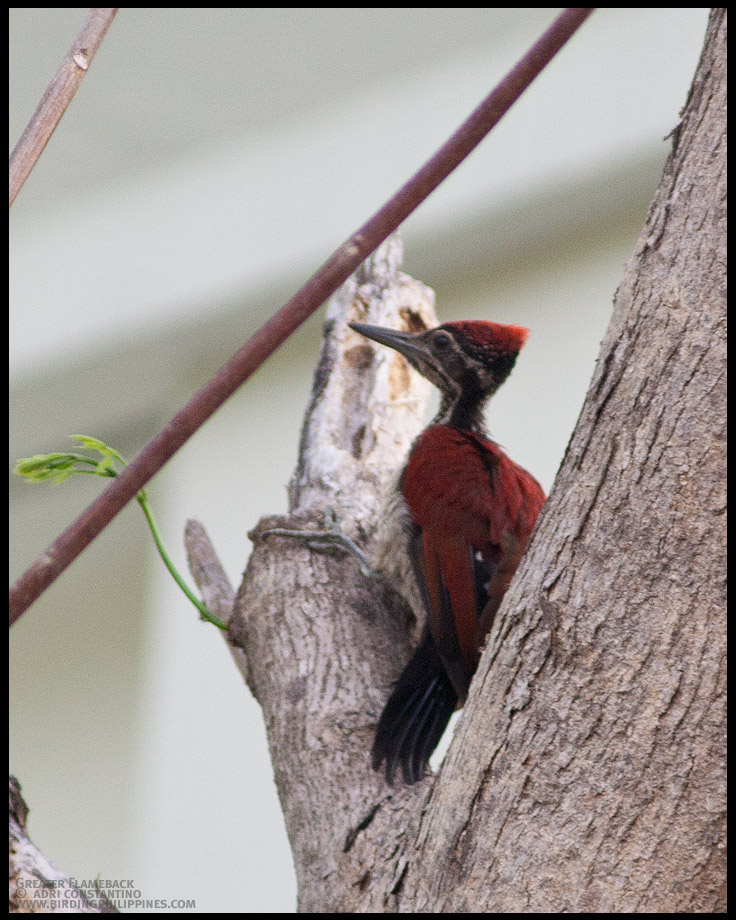
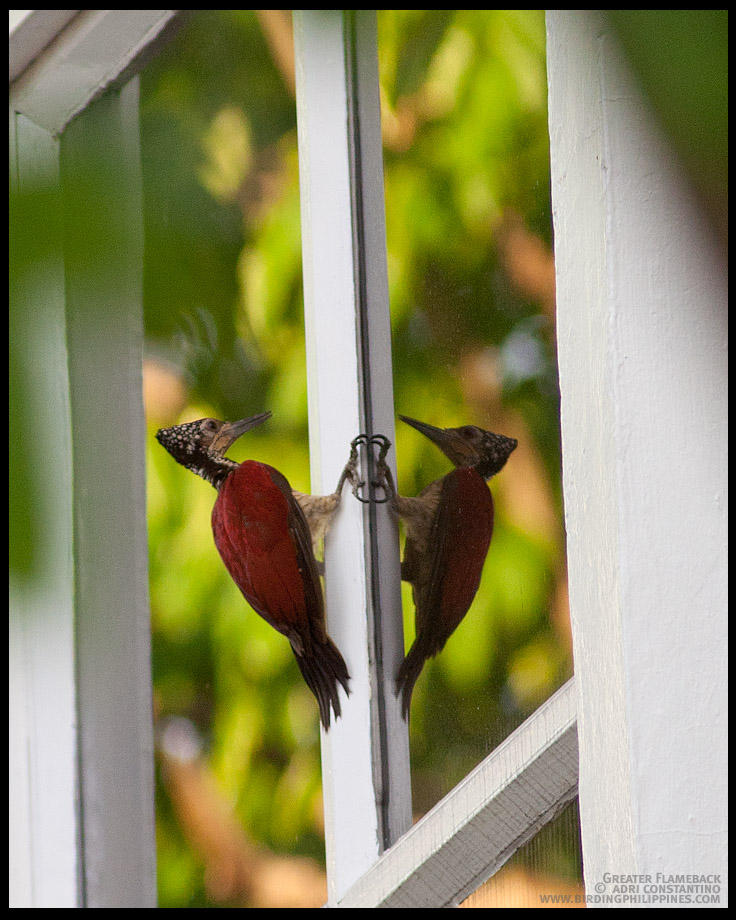
Birding Adventure Philippines birder Trinket Canlas shares her recent experience with a pair of Greater Flamebacks in Subic Bay, Luzon, Philippines.
A male Greater (Luzon) Flameback minding his own businesswhile the female violently pecks away at its own reflection
“On the wall, flameback,” Adri communicated to me in a low voice. He was standing maybe 10 meters away from me, having come down the stairs while i stood on the sloping asphalt driveway.
We were at the parking lot of the (former) legenda suites at cubi-triboa district in subic, having left local birders drew, kitty and ivan at the street corner looking at blue-naped parrots on the agoho trees.
I looked at the tree beside the hotel wall, and saw a male woodpecker creeping up and down the tree trunk going about the usual woodpecker routine.
“yup, male!” i answered adri.
“SA WALL!(ON THE WALL!)” he said again.
“oo nga! male! (yes! male!)” i wondered what the insistence was about.
“tignan mo SA wall! (look ON the wall!)”
and then i saw it…
the female flameback was actually perched on the vertical concrete wall of the hotel!
“ahhhh… oo nga no! (oh, yes there it is) ”
Talk about un-natural perches. not only that… the female seemed quite agitated. she seemed greatly threatened by another female flameback mirroring, literally, her every move.
She would swoop, fly in, attack, peck. a huge display of aggression… at herself! i could feel her hostility with her every charge and dip. it was of course, just her reflection on the large glass windows of the building she was threatening/threatened by. it was pretty comical to watch, this display of non self-awareness. by this time, kitty, drew and ivan had joined us in our observation.
It was also interesting to note that while this was going on, the male calmly went about his business pecking away at the tree trunk, up and down, peck peck peck. Initially i would think that the male of the species would be the sole aggressor. but then again…
… apparently not.
After all, we each have our own antagonists… (and maybe like the woodpecker, once in a while we don’t realize that our greatest antagonist is our self!)
The Luzon Water Redstart is a an uncommon endemic found only in the islands of Luzon and Mindoro. They favor clear mountain streams and rivers above 300 meters, usually in pairs. They forage for insects disturbed by running water in clean mountain streams. This female individual was captured in one of the highland streams in Mt. Polis, Ifugao and Mountain Provinces in the Cordilleras of northern Luzon, Philippines.
Aside from the Redstart, Mt. Polis holds several other birds that are difficult to get elsewhere in the Philippines. This includes the montane species such as Luzon Scops Owl, Luzon Bush Warbler and if lucky the beautiful Flame-breasted Fruit-dove plus many more Luzon montane birds. Be sure to check out our gallery for a sampling of Mt. Polis birds.
One of the main targets of a birding trip to the Philippines is to see the country’s six endemic kingfishers. We have Philippine Dwarf Kingfisher for the major islands, Spotted Wood and Indigo-banded Kingfishers in Luzon, while Mindanao and its satellite islands have Silvery Kingfisher, Blue-capped Wood Kingfisher and the one featured here in this video: the Rufous-lored Kingfisher.
The Rufous-lored Kingfisher usually inhabits the lowland forests of Mindanao, Bohol, Samar, Leyte and its satellite islands and feeds on small vertebrates such as lizards, frogs and other invertebrates. Like its relative in Luzon, the Spotted Wood Kingfisher, the Rufous-lored Kingfisher is very active in the early morning and is usually given away by its loud and harsh calls. These individuals were recorded during one of our birding trips to PICOP, Bislig, Surigao.
Here’s sharing with you a short video clip of a Yellow-breasted Fruit-dove trying to collect twigs as nesting material. This was taken during one of our custom tours for Jeepney Projects Worldwide. Jeepney Projects Worldwide is a partnering of benefit art projects and regional conservation groups working to inspire support and restore lost habitat of critically endangered birds. They are doing an art benefit project for the Philippine Eagle Foundation in conserving the Philippines’ national bird, the Great Philippine Eagle.
The Yellow-breasted Fruit-dove is one of the five endemic fruit-doves found in the Philippines. It can be found allover the country except the Palawan region and inhabits forest and forest edge in lowland and montane forests usually taking advantage of fruiting trees. Locally called Punay, it is one of the most colorful fruit-doves in the Philippines.
Which one do you think is prettier, this Yellow-breasted Fruit-dove or its high-elevation-Luzon-only cousin, Flame-breasted Fruit-dove?
Yellow-breasted Fruit-DovePtilinopus occipitalis January 2011, Mt. Kitanglad, Bukidnon, Mindanao, Philippines Video by Nicky Icarangal, JR. Digiscoped with a Swarovski ATM 80 HD, Canon Powershot S95.